
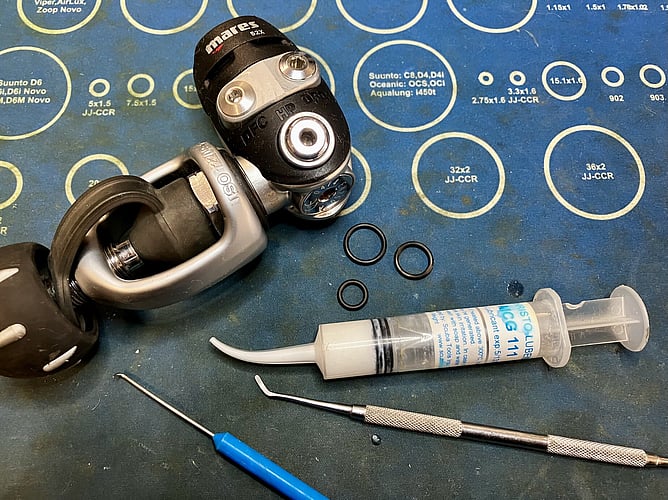
The Little Tube of Grease That Makes a Big Difference
Why Aotearoa Dive chooses premium lubrication for every equipment service – and why we believe it matters.
When it comes to scuba equipment servicing, there are some things you simply don’t compromise on. Cleanliness, attention to detail, correct components and, perhaps surprisingly, the type of grease used during reassembly.
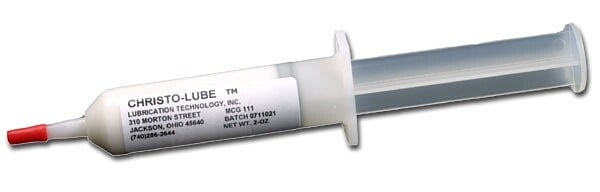
One product that has earned an important place on the workbench at Aotearoa Dive is Christo-Lube MCG 111. You might think grease is just grease. After all, it’s only there to lubricate an O-ring, isn’t it? Well, not quite. When you’re dealing with high-pressure breathing systems, oxygen-enriched gases, precision regulators and equipment that quite literally keeps people alive underwater, the choice of lubricant becomes considerably more important.
At Aotearoa Dive, we use Christo-Lube throughout our equipment servicing wherever lubrication is required and permitted by the equipment manufacturer’s specifications. And yes, it costs considerably more than ordinary silicone grease. We use it anyway. Here’s why.
A little history: Where did Christo-Lube come from?
Christo-Lube is a specialist range of high-performance lubricants developed for applications where conventional lubricants simply aren’t good enough.
Its development and adoption are closely associated with demanding industrial, aerospace, oxygen-system and military applications, where chemical stability, material compatibility and resistance to extreme operating conditions are essential.
By the mid-1990s, Christo-Lube MCG 111 was already documented in chemical safety records, and it subsequently became an established choice for oxygen-compatible lubrication in breathing apparatus and diving systems.
Its reputation comes from its ability to perform in environments where ordinary petroleum-based and silicone lubricants can introduce unwanted chemical interactions or compatibility problems.
Today, Christo-Lube is used in a variety of specialist applications, including:
● Scuba diving regulators and breathing apparatus.
● Oxygen and medical gas systems.
● Aviation oxygen equipment.
● Industrial valves and high-pressure systems.
● Sealing applications involving specialist elastomers and plastics.
In other words, this isn’t something originally developed for greasing the hinges on your garden gate!
What’s actually inside Christo-Lube?
This is where things get interesting.
Christo-Lube MCG 111 is a fully fluorinated lubricant. Its principal chemistry is based on two important materials:
1. Perfluoropolyether (PFPE)
PFPE is a synthetic fluorinated lubricant that provides the grease with its exceptional chemical stability.
Unlike conventional hydrocarbon-based oils and greases, PFPE has outstanding resistance to oxidation and many aggressive chemicals. It is also highly resistant to reaction with oxygen under its intended operating conditions.
This makes it particularly valuable in high-pressure oxygen applications, where lubricant selection is a critical safety consideration.
2. Polytetrafluoroethylene (PTFE)
You may recognise PTFE by its more familiar trade name, Teflon.
In Christo-Lube, PTFE acts as the thickening component, helping give the lubricant its grease-like consistency and providing the desired lubricating characteristics.
The combination produces a chemically stable, water-resistant lubricant with excellent material compatibility across many commonly used metals, plastics and elastomers.
It also performs across a very wide operating temperature range.
Importantly, Christo-Lube MCG 111 is qualified to MIL-PRF-27617, a military specification for specialist oxygen-compatible lubricants. That’s a rather impressive pedigree for something that comes in a little tube.
Why does this matter when servicing scuba equipment?
A modern scuba regulator is a sophisticated piece of engineering.
Inside are numerous O-rings, sealing surfaces, moving components, springs and precision-machined parts. Each has a specific job, and every component must operate reliably under changing pressures, temperatures and environmental conditions.
Lubrication plays several important roles:
Protecting O-rings during assembly
A correctly lubricated O-ring is less likely to twist, pinch or become damaged during installation. This helps achieve a reliable seal and reduces unnecessary wear.
Reducing friction
Moving components benefit from appropriate lubrication, helping maintain smooth operation and reducing friction where specified by the manufacturer.
Supporting material compatibility
Not every lubricant is compatible with every rubber compound, plastic or elastomer. Choosing the correct lubricant helps avoid material deterioration and premature seal failure.
Water and chemical resistance
Christo-Lube offers excellent resistance to water and many chemicals, making it particularly useful in demanding marine and breathing-gas environments.
Oxygen compatibility
Perhaps its most important advantage is its suitability for appropriately prepared oxygen-service equipment.
This is particularly relevant when servicing regulators intended for enriched air Nitrox and other oxygen-enriched applications, subject to the regulator manufacturer’s specifications and the applicable oxygen-service requirements.
It is important to understand that using Christo-Lube alone does not make a regulator oxygen-clean. Proper cleaning, contamination control, compatible components and correct assembly procedures are equally essential.
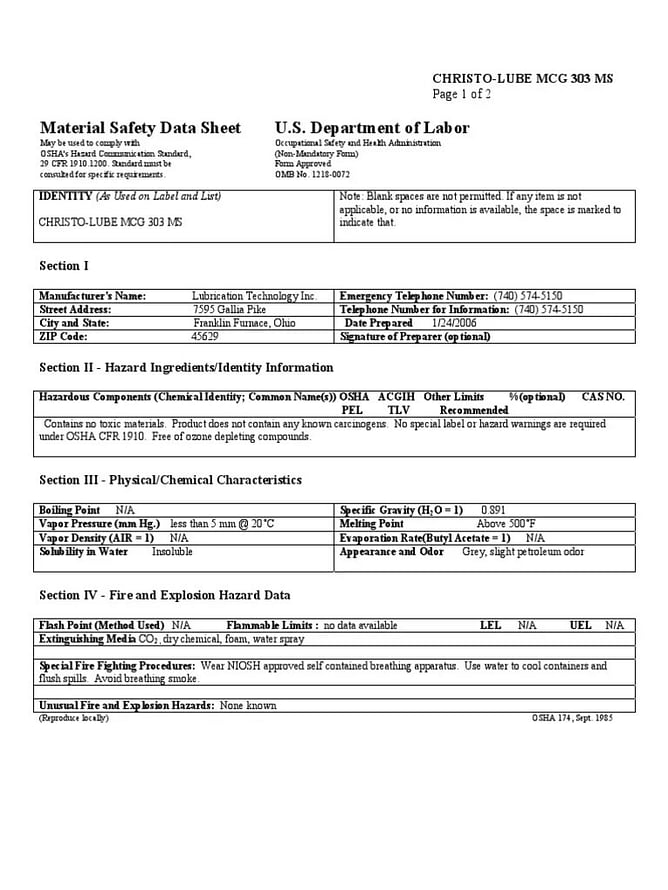
Christo-Lube versus silicone grease: Is there really a difference?
Absolutely.
Silicone grease has its place in diving equipment maintenance. It can be suitable for certain external seals, water-contact applications and other components where the manufacturer specifically permits it. However, it is not an equivalent alternative to Christo-Lube MCG 111. The two products have fundamentally different chemical compositions and performance characteristics. The biggest distinction is oxygen compatibility.
Conventional silicone grease should not be substituted for an approved oxygen-compatible lubricant in equipment intended for oxygen-enriched service. Contamination from an incompatible lubricant can compromise the oxygen-service status of the entire affected system.
There are also differences in chemical resistance, operating characteristics and suitability for particular high-pressure applications. Another important consideration is that excessive grease of any type can attract particulate contamination and potentially interfere with component operation. More grease does not mean better servicing. A good technician understands that the correct lubricant, applied in the correct quantity, is what matters.
Why Aotearoa Dive uses Christo-Lube on all our equipment servicing
At Aotearoa Dive, we have a straightforward philosophy:
We would rather spend a little more doing the job properly than save a few dollars and compromise our servicing standards. Christo-Lube is considerably more expensive than ordinary silicone grease. There is no getting around that. But when we’re servicing someone’s regulator, we’re not simply trying to get it out of the workshop as quickly or cheaply as possible. We’re working on equipment that someone will depend upon metres from the surface, potentially in challenging conditions, and often a considerable distance from assistance.
That responsibility deserves a different mindset.
We have invested in professional servicing equipment, appropriate cleaning procedures, quality replacement components and the specialist materials required to maintain diving equipment to a high standard. Using Christo-Lube is part of that commitment.
We don’t believe that the cheapest consumables necessarily represent the best value. In fact, when it comes to life-support equipment, the economics of cutting corners are rather difficult to justify.
Our customers aren’t paying us simply to replace a few O-rings and put a regulator back together. They’re paying for experience, technical knowledge, attention to detail and a servicing philosophy that puts equipment integrity first. And if using a more expensive lubricant contributes to achieving that standard, it’s an easy decision.
A word of caution: Ask what’s going on inside your regulator!
Here’s something worth considering the next time you take your regulator in for servicing.
Ask your dive centre or service technician what lubricant they use.
Ask whether they use an oxygen-compatible lubricant where required, and whether their cleaning and assembly procedures meet the equipment manufacturer’s requirements.
If a service centre relies predominantly on ordinary silicone grease for internal regulator servicing, particularly where regulators may be used with Nitrox or other oxygen-enriched mixtures, we would strongly recommend asking some questions.
Silicone grease isn’t automatically wrong for every diving application, but it should never be treated as a universal substitute for specialist oxygen-compatible lubricants.
A technician who cannot explain why they have selected a particular lubricant, or who dismisses the importance of oxygen compatibility, should give you reason to pause. Very often the manufacturers of regulators will specify Christo-Lube in servicing procedures, NOT SILICONE GREASE!
Don’t be afraid to ask questions. It’s your equipment, your money and, ultimately, your life-support system. A professional service centre should be perfectly comfortable explaining its procedures and the products it uses.
The Aotearoa Dive difference
At Aotearoa Dive, we believe professional servicing is about much more than having the right tools - It’s about having the right mindset.
We believe in doing things properly, following manufacturer specifications, understanding the chemistry behind the products we use and never allowing the cost of a consumable to dictate the quality of our work.
Christo-Lube MCG 111 might cost more than the little tub of silicone grease sitting on somebody else’s workbench. But we know what we’re putting into your equipment, why we’re putting it there and what we’re trying to achieve.
And that’s precisely the point...
Your regulator deserves more than a quick clean, a smear of generic grease and a pat on the back. It deserves professional attention, quality materials and an experienced technician who understands the responsibility that comes with servicing life-support equipment.
At Aotearoa Dive, that’s the standard we choose to work to.
Because underwater, there really is no substitute for getting things right.
Aotearoa Dive – Quality, experience and attention to detail. Every service. Every time.
If you are interested in learning more about how to correctly look after your equipment CLICK HERE
For those dive professionals wanting to learn more and become accomplished SCUBA service technicians, we offer training programs to suit your personal requirements. Find out more by CLICKING HERE