
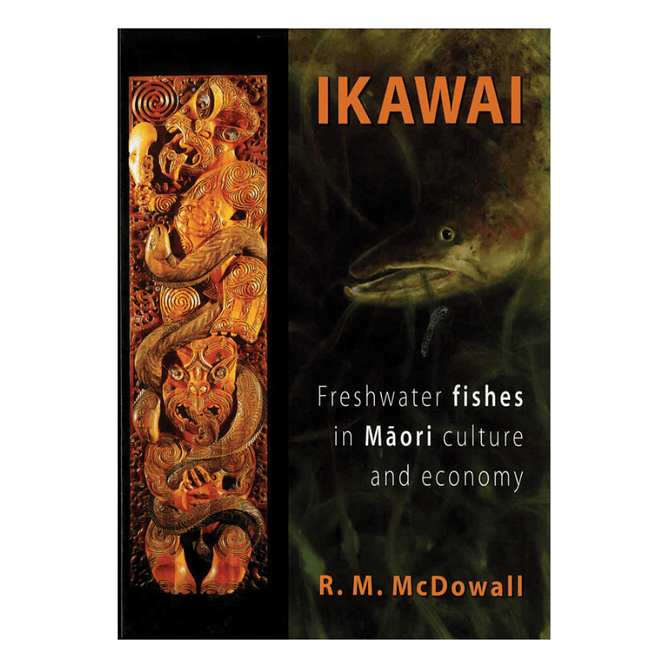
A Monumental Undertaking
Ikawai: Freshwater Fishes in Māori Culture and Economy represents an unparalleled synthesis of biological science and Indigenous knowledge, anchored in New Zealand’s deep interconnection between ecology and culture. Authored by renowned ichthyologist Dr Robert Montgomery (Bob) McDowall, this work stands as his final and arguably most ambitious publication. McDowall was a towering figure in freshwater biology; over a four-decade career he published 14 books and over two hundred scientific papers, earning recognition as a Fellow of the Royal Society of New Zealand and international respect for his mastery of galaxiid taxonomy and fish ecology. Ikawai was completed shortly before his passing in 2011 and posthumously published later that year — a fitting capstone to a life’s work that bridged scientific rigour with historical and cultural interpretation.
Measuring 832 pages and richly illustrated with historical and contemporary photographs, sketches, and Māori art, Ikawai sets out to compile and interpret all recorded knowledge regarding freshwater fish usage by Māori — from early explorer accounts and ethnographies to tribunal reports and modern biological research.
The result is nothing short of a magisterial compendium: at once an environmental history, cultural anthropology, biological reference, and a reclamation of Indigenous ecological knowledge. But Ikawai is neither light reading nor a conventional narrative — it is meticulously detailed, occasionally repetitive, and structurally encyclopaedic. Its value lies in its exhaustiveness, its critical approach, and its commitment to situating traditional Māori fisheries within both historic practice and ecological science.
Scope and Structure: What Ikawai Seeks to Do
McDowall’s purpose is twofold:
Documentation and Preservation — to gather scattered, often obscure ethnographic, historical, and archaeological records on Māori freshwater fisheries and consolidate them into one coherent resource.
Interpretation and Critique — to evaluate these records with modern scientific understanding of fish biology and ecology, and thereby clarify the roles and meanings of fish species within Māori subsistence, cultural practice, and worldview.
The book opens with introductory chapters that lay out the environmental setting of Aotearoa’s freshwater ecosystems, the arrival of Māori and the pre-European fish fauna they encountered, and definitions of key cultural concepts. McDowall then devotes many subsequent chapters to detailed examinations of individual fish species or species groups (e.g., tuna/eels, kanakana/lamprey, īnaka/whitebait, kōkopu/galaxiids). Each of these sections encompasses discussion of:
Māori names, regional variations, and ethno-linguistic context
Traditional fishing methods and technologies
Māori ecological knowledge of species’ life histories
Preparation, cooking, preservation, and storage
Mythology, waiata (songs), whakataukī (proverbs), and narrative tradition referencing the species
Changes over time due to colonisation, introduction of exotic fish (e.g., trout), legal restrictions, and environmental degradation.
The book thus occupies disciplinary intersections rarely combined in scholarship: ethnohistory, ethno-ichthyology, cultural anthropology, and environmental history.
Key Themes and Contributions
1. Indigenous Knowledge and Environmental Insight
One of the greatest strengths of Ikawai is its profound respect for Māori ecological knowledge — mātauranga Māori — and its insistence that such knowledge be understood on its own terms. McDowall documents the subtlety and precision with which Māori named, categorised, and interacted with freshwater fish species, demonstrating that this knowledge system was not only culturally meaningful but ecologically sophisticated. For example, the myriad names for tuna (eels) reflect seasonal behaviour, morphology, and local ecological conditions — a depth of understanding that reflects long-term observation and experiential learning.
Far from romanticising or fossilising Māori culture, McDowall treats traditional knowledge as evidence of complex ecological adaptation and management — such as rāhui (customary restrictions on fishing areas or seasons), food preservation practices, and strategies for preserving life histories of migratory fish.
McDowall’s approach is not uncritical, however. He recognises challenges in interpreting historical sources — particularly when nineteenth-century ethnographers used inconsistent nomenclature, misinterpreted Māori terms, or introduced Western biases into their recordings. McDowall often unravels these inconsistencies through his scientific expertise, providing clarity and context.
2. Tuna (Eels) as Food, Economy, and Cultural Icon
No single species receives more attention in Ikawai than tuna — freshwater eels — and with good reason. At nearly 100 pages, the eel chapter is the most extensive in the book and illustrates the centrality of tuna in Māori diet, economy, and cosmology.
McDowall explores not only the various customary fishing methods (e.g., īnaki, pā tuna weirs, hand-catching, torch-fishing) and preservation techniques (smoking, drying, kelp-bag storage), but also the role of tuna in tribal movements, food security, and even ceremonial exchange. Eels provided a reliable protein source, a rich supply of fats, and were widely harvested — sometimes in quantities measured in the tens of thousands.
This chapter also exemplifies the book’s integrated methodology: weaving together biological life-cycle knowledge (migration patterns, habitat preferences) with traditional practice and historical records to present a more holistic picture than either ecological science or anthropology could alone.
3. The Impacts of Colonisation and Introduced Species
A recurring theme throughout Ikawai — and one that resonates with broader environmental history — is the decline of customary Māori freshwater fisheries in the post-contact period. McDowall carefully documents how European colonisation altered landscapes, water quality, river flows, and species composition. The introduction of trout and other exotic fish, for instance, had both ecological and socio-legal consequences: predation on native species, competition for resources, and restrictions on Māori fishing practices due to licence requirements and conservation laws.
This part of the narrative is both illuminating and sobering, demonstrating how colonial governance frameworks often criminalised Indigenous fishing practices even when those practices were sustainable and culturally vital. Trout fishing regulations, for example, made the capture of trout — a species never consulted about introduction — illegal for Māori in certain waters, highlighting broader patterns of dispossession and legal marginalisation.
4. Archaeology, Artefacts, and Visual Documentation
Ikawai is notable not just for textual analysis, but for its visual assemblage. McDowall includes dozens of images: historic photographs of fishing practices, artefacts, carved objects, woven nets, traditional artworks, and scientific illustrations. These visual elements serve several functions:
They contextualise traditional practices and materials (e.g., types of nets or weirs).
They demonstrate continuity and change over time.
They capture the aesthetic and symbolic dimensions of fish-related culture that words alone cannot convey.
This visual richness also supports the book’s claim to be an archival repository: many images and artefacts come from collections that are otherwise difficult to access.
Engagement with Scholarship: Strengths and LimitationsStrengths
Exhaustive research — McDowall’s immersion in both Māori cultural sources and biological literature makes Ikawai unmatched as a reference work.
Interdisciplinary clarity — his ability to move between scientific analysis and cultural context without subordinating either is rare.
Cultural respect — the book treats Māori perspectives not as curiosities but as substantive ecological knowledge systems.
Illustrative depth — the images and artefacts help bridge historical understanding with material culture.
Limitations
Density and redundancy — as noted by reviewers, the encyclopaedic format — while valuable as a reference — can feel repetitive and labour-intensive for continuous cover-to-cover reading. Many chapters revisit similar stories or details that might be more effective in modular reference form than sequential narrative.
Typographical inconsistencies — minor editorial errors occasionally distract, though they do not detract substantially from the overall content.
Audience specificity — readers without backgrounds in Māori culture, freshwater ecology, or ethnography may find certain sections challenging. Ikawai is rewarding but demands patience and sometimes supplemental knowledge to fully appreciate.
Critical Reception and Scholarly Impact
The academic reception of Ikawai confirms its significance. Peer reviewers from fields such as environmental history and Indigenous studies have highlighted the book’s value as a foundational resource in Māori ecological scholarship. The formal review by Brendan J. Hicks and E.M. Watene-Rawiri in the New Zealand Journal of Marine and Freshwater Research recognises the volume’s rigorous documentation and cultural sensitivity.
Ian C. Duggan’s commentary for the Australian & Aotearoa New Zealand Environmental History Network summarises the book as indispensable for those interested in Māori-freshwater relationships precisely because it brings wide-ranging and scattered sources into an accessible — if voluminous — format.
Conclusion: A Landmark in Environmental and Cultural Scholarship
Ikawai: Freshwater Fishes in Māori Culture and Economy is a landmark scholarly achievement. Its depth and breadth make it an essential reference for generations of researchers in Indigenous studies, environmental history, anthropology, ichthyology, and New Zealand studies. McDowall’s work foregrounds Indigenous ecological knowledge as legitimate, data-rich, and deeply interconnected with human and environmental wellbeing — a message that grows only more relevant in the context of contemporary ecological crises, water politics, and cultural revitalisation.
The enduring legacy of Ikawai lies not merely in its encyclopaedic content, but in its demonstration of how science and culture can be woven together to honour both empirical inquiry and Indigenous worldviews. It is both an academic monument and a cultural treasure — one that will likely shape understandings of freshwater ecosystems and Māori environmental relationships for decades to come.
We have a copy of this amazing book in our library at Aotearoa Dive. If you would like to have a look for yourself, please do call in for a coffee!