The story beneath the surface
The Story Beneath the Surface: The History of Shearwater Dive Computers and the Company That Built Them
In the world of scuba diving, where life support systems are pushed to their limits and every instrument must be as reliable as a diver’s own training, dive computers occupy a sacred place. Among these, Shearwater dive computers have become legend — not merely for their technical excellence but for the philosophy and passion behind their creation. This is the story of how a small Canadian company transformed an industry niche into a global standard for serious divers.
⸻
A World Before Shearwater
Before Shearwater’s rise, dive computers were far from ubiquitous. Early designs in the 1980s — like the Orca EDGE, one of the first microprocessor-based dive computers — showed how electronic computing could change how divers manage decompression and dive planning underwater. These large, brick-like computers revolutionized multi-level diving, yet by the early 2000s, there remained a significant gap: devices powerful enough for technical divers — who use gas mixes like trimix and often dive with rebreathers — were limited and frequently overly complex and unintuitive. 
Technical diving is inherently demanding. With deeper depths and mixed gases come greater risks of decompression sickness, narcosis, and life-threatening errors if dive profiles aren’t precisely managed. Yet many computers of this era were designed more for recreational divers than for the needs of advanced, often military or scientific, divers. This disconnect set the stage for something new.
⸻
Foundations in Passion: Bruce Partridge and the Birth of Shearwater
The year was 2004 when Bruce Partridge, a Canadian with a deep background in computing and a growing passion for technical diving, took a leap that would reshape the dive computer landscape. Partridge had a long career in computer systems design, embedded programming, and advanced technical diving — a rare combination that uniquely positioned him to tackle a glaring problem in dive equipment design. 
Bruce’s journey didn’t begin with electronics, but with an obsession for diving — so much so that he once purchased a CCR2000, an early closed-circuit rebreather, and spent hours discussing its electronics with its designers. These interactions offered him an intimate look into the challenges divers faced with then-available computers and mouth-tedious control systems. 
By 2004, Partridge had incorporated Shearwater Research Inc. in Vancouver, Canada, with one simple mission: to build dive computers that were powerful, simple, and reliable — especially for technical divers who had few options that could handle complex gas mixtures and decompression needs while maintaining usability. 
The company’s name — Shearwater — references a seabird known for its long, dynamic flights over oceans, a metaphor for exploration and resilience — traits befitting both divers and the gear that supports them.
Operating from a spare bedroom, Shearwater’s earliest work involved building electronic controller boards for rebreathers such as the ISC Megalodon. These controllers helped manage partial pressure of oxygen (PPO₂) within the breathing loop — a function critical to rebreather safety. Partridge’s early involvement coincided with a wave of interest in rebreather diving, which further emphasized the need for reliable, intuitive electronics. 
⸻
The First Computers: From GF Controller to Pursuit
Shearwater’s first major product was the GF Controller, named for its implementation of gradient factors — a decompression model allowing divers to adjust conservatism for their profiles. Introduced soon after the company’s founding, this controller was designed to manage a rebreather’s oxygen delivery and decompression calculations. 
In 2006, Shearwater released its first stand-alone technical dive computer, the Pursuit. This was a watershed moment. Unlike many computers at the time, which were either too simplistic or wildly complex, the Pursuit managed to balance technical capability with a clean, intuitive interface — a design ethos that would become Shearwater’s hallmark. 
This early focus on user-friendly interface design was deliberate. Partridge and the team believed that in high-stress dive situations, divers should be able to access critical data quickly and accurately without wrestling with menus — a perspective that distinguished Shearwater from competitors. 
⸻
Predator, Petrel, and the OLED Revolution
By 2009, Shearwater introduced the Predator — perhaps the first major indicator that Shearwater was ready to lead the dive computer market.
The Predator introduced several innovations that would define modern dive computers:
• OLED display: Brighter and more readable than previous LCDs, helping divers see key information in low light conditions. 
• Bluetooth syncing: Allowing wireless data transfer to desktop software; a significant interface improvement. 
• Multi-gas capability: Supporting up to five gases for both rebreather and open-circuit divers, with elegant in-dive gas switching. 
The Predator’s success proved that technical divers were hungry for computers that didn’t compromise powerful algorithmic capabilities for ease of use.
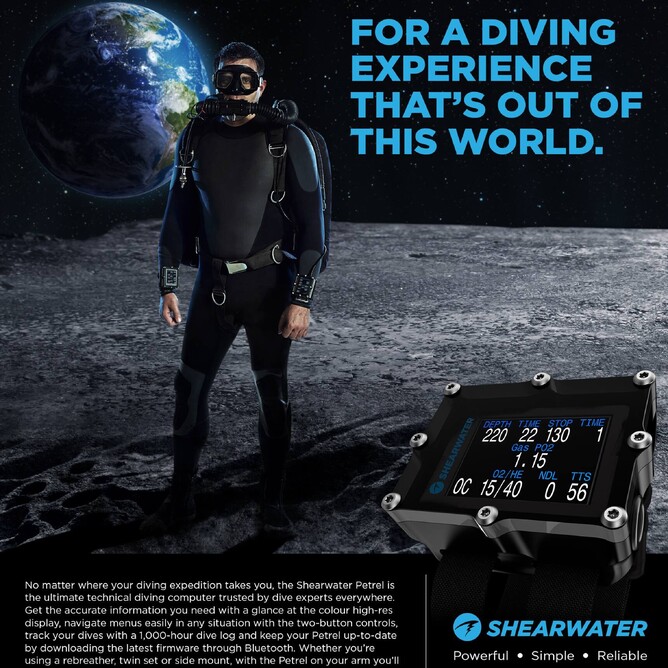
In 2012, Shearwater followed with the Petrel — essentially an enhanced version of the Predator. Smaller, with improved battery life (standard AA), automatic brightness adjustments, and vastly increased log memory, the Petrel quickly became a favorite among technical divers and expedition teams. 
⸻
Innovation and Expansion: NERD, Perdix, and Beyond
The early 2010s were a period of rapid innovation at Shearwater:
The NERD (Near Eye Remote Display)
In 2013, Shearwater released the NERD — a head-up display that placed dive data directly in the diver’s line of sight. This system pioneered the integration of advanced dive info without forcing the diver to look away from their environment. 
Its successor, the NERD 2, refined this concept further by embedding all electronics within the eyepiece itself, improving usability and adding air integration and compass functions. 
The Perdix Series
By 2015, Shearwater launched the Perdix — a wrist-mounted computer that marked an evolution toward even more ergonomic, accessible designs. Named after the grey partridge (Perdix perdix), this model offered:
• Longer battery life than Petrel
• Thinner profile for wrist comfort
• Standardized features for both open circuit and technical use 
The Perdix AI version followed in 2016, adding air integration via wireless transmitters — a major step for divers who wanted real-time tank pressure displayed alongside decompression data. 
⸻
Shearwater’s Philosophy: Simple, Powerful, Reliable
At its core, Shearwater’s success derived from a design philosophy captured in three words: powerful, simple, reliable. These weren’t mere marketing slogans — they were engineering mandates.
Every Shearwater product used industry-standard decompression algorithms — such as Bühlmann ZH-16 with gradient factors and the VPM-B model — but presented them in ways divers could actually interpret during a dive. 
Unlike some manufacturers who obscure algorithm parameters, Shearwater allowed divers to see and adjust key settings, fostering better understanding and control. This transparency was a hallmark of the brand’s trust-building with users.
Recognition, Growth, and Industry Impact
Shearwater’s rapid rise didn’t go unnoticed:
• In 2013, the company received the International System Safety Society Award for scientific research and development — a testament to their contributions to dive safety and electronics. 
• The Petrel won acclaim not only for performance but also for user-centered design. 
• Shearwater’s commitment to quality means all products meet CE, FCC, and IC standards, and their dive computers are designed and manufactured in Canada. 
Further testament to their influence: Shearwater dive computers have been used on deep technical expeditions, including wreck exploration and scientific dives to more than 150 meters — places where robust, reliable computing isn’t just convenient, it’s life-critical. 
⸻
Transition and New Leadership
In the late 2010s and early 2020s, Shearwater entered a new chapter. Around 2018-2021, Bruce Partridge stepped down from day-to-day leadership, transitioning to a board role. The company was partially acquired by private equity in 2021, enabling further growth and expansion, particularly into the recreational dive market. 
Under new leadership, Shearwater continued innovating:
• Watch-style computers like the Teric and later Tern and Tern TX provided technical capabilities in wearable formats that appealed to broader diver demographics. 
• Avelo mode and partnerships with buoyancy system innovators expanded what dive computers could do beyond decompression — integrating real-time buoyancy data into dive planning. 
Today, Shearwater employs over 100 people, with a global dealer network and products manufactured in a modern facility in Richmond, British Columbia. 
Legacy and Influence
Shearwater’s influence on dive computers is profound:
• Technical divers once burdened by confusing interfaces now had tools that emphasized clarity and reliability.
• Recreational divers benefited from features once reserved for professionals.
• Military and research diving programs have adopted Shearwater technology for operational use, underscoring its real-world robustness. 
Moreover, Shearwater’s approach has helped shift the industry toward more intuitive, user-friendly computer interfaces that don’t compromise computational power — an invaluable contribution to diver safety and confidence.
⸻
Conclusion: From Bedroom Startup to Diving Powerhouse
In just over two decades, Shearwater Research grew from a bedroom-built prototype to a global leader in dive computing. Its story is one of passion — a blend of technical expertise and a deep understanding of divers’ needs, driven by founder Bruce Partridge’s vision. 
Shearwater’s dive computers exemplify what happens when innovation meets simplicity, and when engineers design with empathy for real human challenges — especially those faced hundreds of feet below the ocean’s surface. Today, whether exploring wrecks, mapping reefs, or training new divers, the legacy of Shearwater’s design principles lives on in every dive their computers support.
Why Aotearoa Dive Chooses Shearwater
At Aotearoa Dive, equipment selection is driven by one principle above all others: absolute trust underwater. That is why Aotearoa Dive is proud to be an official Shearwater dealer, supplying and supporting a full range of Shearwater dive computers for recreational, sidemount, and technical diving throughout Aotearoa New Zealand.
Shearwater computers are not chosen for marketing appeal or trend — they are chosen because they perform consistently in the environments our divers actually operate in. From cold-water coastal dives and deep wreck explorations to advanced mixed-gas diving, Shearwater’s reliability, clarity, and algorithm transparency make them the standard tool across our operation.
⸻
The Computer of Choice for Our Dive Professionals
Every Aotearoa Dive professional, from instructors and divemasters to technical and sidemount instructors, dives exclusively on Shearwater computers. This is not coincidence — it is the result of years of real-world testing, redundancy planning, and experience in demanding dive conditions.
For sidemount diving, where gas management, clarity, and in-dive decision making are critical, models such as the Perdix AI, Petrel, and Teric provide clear multi-gas displays, intuitive switching, and optional air integration that integrates seamlessly with sidemount configurations. The ability to instantly verify decompression obligations, remaining gas, and ascent strategy without menu confusion is essential when diving independent cylinders — and Shearwater excels here.
In technical diving, where decompression precision is non-negotiable, Shearwater’s implementation of Bühlmann ZH-16 with Gradient Factors gives divers full visibility and control over their decompression model. This transparency aligns perfectly with modern technical training philosophies and allows our instructors to teach decompression theory using the same tools students will rely on in real-world diving.
⸻
Standardisation, Safety, and Training Consistency
One of the key advantages of standardising on Shearwater across Aotearoa Dive is training consistency. When instructors and students use the same computers, communication underwater is clearer, briefing and debriefing are more effective, and emergency procedures are easier to manage.
Shearwater’s clean interface, logical menu structure, and high-contrast displays reduce task loading — particularly important during complex dives involving multiple gases, stages, or extended decompression. This simplicity supports better decision-making under stress and allows divers to focus on awareness, buoyancy, and team protocols rather than fighting technology.
From entry-level sidemount courses through to advanced XR training programs, Shearwater computers form the backbone of our dive planning, execution, and post-dive analysis.
⸻
Local Support Backed by Global Engineering
As an official dealer, Aotearoa Dive provides local support, setup assistance, firmware guidance, and training integration for Shearwater users. Divers purchasing through Aotearoa Dive benefit not only from world-class Canadian engineering, but also from hands-on expertise from professionals who actively dive these computers in New Zealand conditions.
This partnership reflects a shared philosophy between Shearwater and Aotearoa Dive:
build and use equipment that is powerful, simple, and dependable — because underwater is not the place for compromise.
Check out our Shearwater range by CLICKING HERE
For support and downloads CLICK HERE
Access Dive Shearwater app HERE.